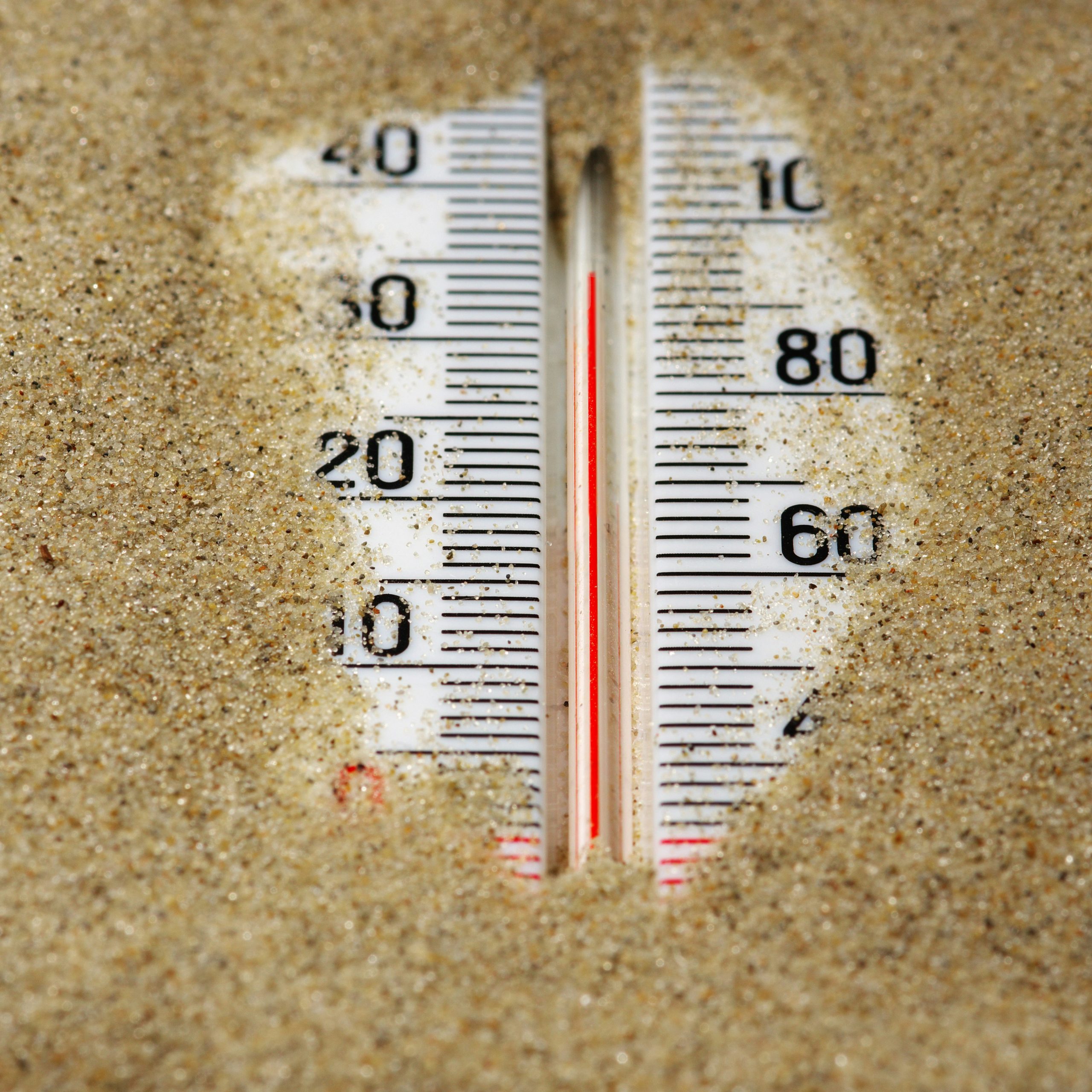
$835 billion evaporated in the heat. How much of it was yours? The thermometer is now a financial indicator. Read it as one.
There is a number that did not appear on your dashboard this year, and it should have: 14.97°C.
That was the global average temperature in 2025 — the third-warmest year ever recorded, according to Copernicus. This is not a meteorological footnote. It is the third step on a staircase that only goes up. 2024 was the warmest year on record, at 1.60°C above pre-industrial levels, and the 2023–2025 period has crossed — for the first time in the instrumental record — that 1.5°C line we were told for a decade we must never touch.
We have touched it. And we did so while most boards were still treating climate as a matter of reputation, of the sustainability report, of the person seated at the back of the room.
Let me be direct, because we know each other: this is no longer about reputation. It is about your bottom line. Treating climate as a financial risk is now simply reading reality accurately.
Heat is not a headline. It is a line in your P&L.
In 2023, the world lost an estimated 512 billion hours of labour to extreme heat. Translated into money: $835 billion in income that was simply never generated. It was not destroyed in a dramatic fire or flood. It evaporated quietly — in factories that slowed down, on sites that stopped at midday, in offices where productivity falls with every degree above 30°C.
In the United States alone, heat-driven losses in labour productivity already cost around $100 billion a year. And the projections leave little room for interpretation: they could double to roughly $200 billion by 2030 and reach $500 billion by 2050 if we carry on as we are.
For those of us operating in southern Europe, the figure is even more uncomfortable: some studies project losses of 3% to 5% of GDP from reduced labour productivity alone by 2080 under the worst scenarios. This is not a Pacific-island problem. It is a problem for Seville, Murcia, Milan — for your plant in Extremadura and your sales team in Andalusia.
When the global cost of lost working time surpasses 1% of world GDP by 2030 — some $2.4 trillion — nobody will be able to say they did not see it coming. It is already in the books.
Your generation of executives made one miscalculation
For twenty years we have managed climate as a liability: something to report, mitigate, offset. A cost centre. A box to tick so that Brussels, the regulator or the fund of the day would leave us in peace.
That mental frame is exactly what is now costing us money.
Because while some saw a liability, others were building the largest reallocation of capital in history. The energy transition, thermal efficiency, infrastructure adaptation, the reinvention of supply chains that today break every time there is a heatwave on the other side of the world. None of that is philanthropy. It is the largest market you will see in your career.
The difference between the companies that emerge stronger from this decade and those absorbed or wiped out will not be who had the best ESG report. It will be who understood first that purpose and profit have stopped running on separate tracks — the core of any real purpose-driven strategy.
I am not talking about hollowing out the message with pretty words. I am talking about the opposite: looking at the thermometer the way you look at Euribor, energy prices or the exchange rate — as a variable that moves your business and demands a capital decision, today.
What a CEO and an Investor should be doing this week
Not next decade. This week.
First, put an internal price on climate. If heat costs you working hours, breached contracts and rising insurance premiums, that has a number. Demand it from your CFO. What is not quantified is not managed — and what is not managed ends up managing you.
Second, look at your portfolio with 2035 eyes, not 2015 eyes. How much of your EBITDA depends on geographies, processes or supply chains that heat will structurally make more expensive? And conversely: where is the opportunity to grow by solving that same problem for others? That is where impact capital — social bonds, dual finance — has stopped being a niche and become a competitive advantage.
Third, stop delegating this. Climate is not a topic for the sustainability team. It is a matter of strategy, capital allocation and survival. And those three things are decided in your office, not two floors down.
The question that actually matters
I have advised enough chairs and boards to know that the problem is almost never a lack of data. The data is there. Copernicus publishes it every year with surgical precision.
The problem is the courage to reorder priorities before reality forces you to do it on worse terms.
The 14.97°C of 2025 is not a punishment. It is information — the same information that, twenty years ago, turned a handful of visionaries into the owners of the digital economy while everyone else debated whether the internet was a fad.
The purpose economy is not the friendly version of capitalism. It is its most lucid version: the one that has understood that creating economic, social and environmental value at the same time has stopped being an ethical option and become the only strategy that survives this decade.
The thermometer is already speaking. The only question is whether your board is listening — or whether it would rather wait for the bill to arrive with more interest.
I know which side I want to be on. And you?
Ángel Bonet is President and founder of ImpactCo, a global boutique consultancy specialised in the purpose economy and purpose-driven strategy. If this debate resonates and you want to take it to your executive committee, let’s talk: tribu@impactco.es.