In Spain, 12.8% of young people aged 16 to 18 leave education early. We tend to read that figure as a classroom problem — a matter of teachers, of remedial-education policy. But having accompanied this project from the inside, we have come to understand that it is also a city problem: what happens, afterwards, to thousands of young people without qualifications who stay to live here?
That opportunity, more often than not, can only be offered by a company through its own business model. Not through charity.
The Challenge: A Problem Business Rarely Considers
Early school leaving is not an abstract phenomenon. Behind that statistic are teenagers who, at sixteen, have already decided that the education system has nothing left to offer them.
Most of the responses that exist today act from the classroom inwards: a teacher, a tutor, a support programme. Rarely does anyone ask what the business world could contribute, from the outside, to a problem that ends up determining who has access to a decent working future and who does not.
The Shift: From Isolated Volunteering to Collective Action
For years, the standard corporate response to challenges like this has been corporate volunteering understood as an isolated gesture: a mentoring day, a one-off donation, a well-intentioned communications activity with no continuity.
That model is limited. Each company acts on its own, measures what it can, and rarely sustains the effort beyond a specific campaign. The underlying problem remains, waiting for the next edition of a one-off action.
Board2030 proposes something different: turning that isolated impulse into collective, systemic and measurable action. Several companies analysing a structural city challenge together, committing to concrete indicators, and sustaining that collaboration for as many years as it takes — not for a single quarter.
The Model: Who Sits at the Table
Board2030 is driven by B Lab Spain, EADA Business School and Ferrer, under the umbrella of Barcelona+B. At ImpactCo we are part of this project alongside companies such as Uriach, CBRE, Tram, Deloitte, Hospital Clínic, Cushman & Wakefield and Reig Jofre — a group that in itself says a great deal about the level of commitment required to join.
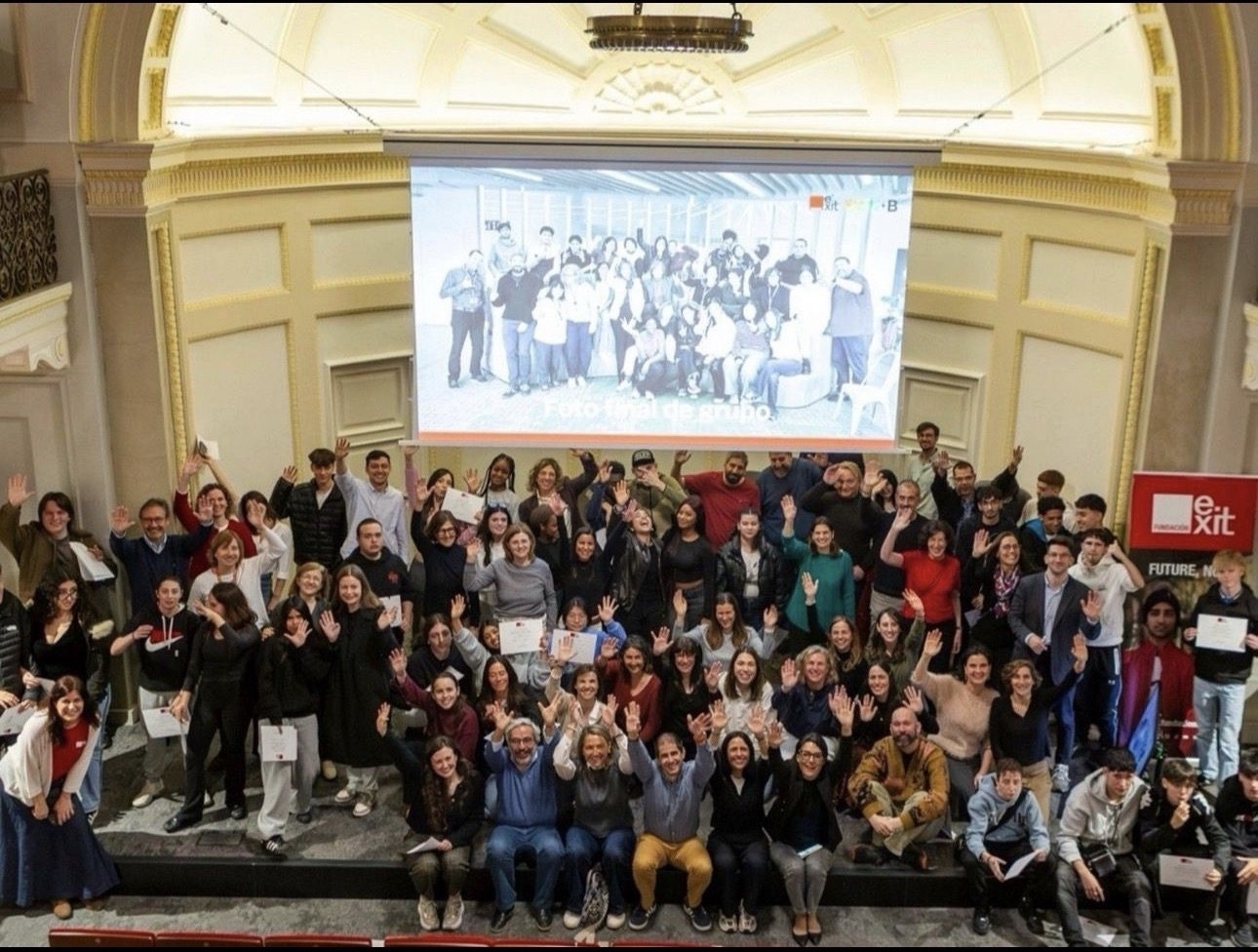
Board2030’s first collective action has focused on early school leaving, in partnership with Fundació Èxit. During the 2025-2026 academic year, the results have been concrete and measurable:
- 272 young people supported across 20 classrooms of Vocational Training and Insertion Programmes.
- 303 corporate volunteers involved.
- A joint investment of more than €510,000.
- 98% of the professionals who took part as mentors recommend the experience.
That last figure is as striking as the statistics about the young people themselves: when the model works, it also transforms the person doing the mentoring.
At ImpactCo we lived this first-hand. Together with Clínica Baviera, Donte Group, Laie and Zurich Insurance, we coordinated one of the twenty classrooms. We did not go there to fix anything: we went to listen, and to believe in young people who, until that moment, had rarely felt anyone look at them that way. From it we take a lesson we apply in our own work: the most valuable leadership skill is not giving answers, but creating a space where someone finally dares to imagine their own future.
Our View: Impact Is Not a Cost Line
At ImpactCo we defend an idea that underpins this entire project: well-designed social impact is a growth lever, not a cost line.
A company that dedicates real time from its teams to solving a challenge in its city gains something that never appears on any balance sheet under that heading. It attracts talent that wants to work for purpose-driven companies, retains professionals who value that commitment, and builds a reputation no communications campaign can buy.
The 98% satisfaction figure among volunteers points in exactly that direction. The new professional generations demand more than a competitive salary: they want to be part of organisations that measure success by something more than quarterly results. The purpose economy does not compete with the bottom line; it competes for the very talent that decides today where it wants to build its career.
Where It Is Heading
Early school leaving has been the entry point, not the final destination. The Board2030 group is already working to transfer this same model — companies analysing challenges together, committing to indicators, sustaining collaboration over time — to other issues that define whether Barcelona is a liveable city for those who live in it: access to housing, youth employability beyond school, and the environmental sustainability of the territory.
None of these challenges is solved with a single volunteering day. They are solved when a group of companies decides they are part of their strategy, and acts accordingly for years — not for an afternoon.
For us, being part of this group is both a matter of conviction and a way of understanding what it truly means to be a purpose-driven company.
ImpactCo is a global boutique consultancy specialised in the purpose economy and a member company of Board2030. If you lead a company and want to build impact that also builds business, let’s talk: tribu@impactco.es.