The LSE has just published a book that rewrites the rules of economic policy. For impact businesses, this is not an academic matter — it is an opportunity.
A few months ago I came across a project that had been taking shape at the London School of Economics — one that, honestly, struck me as far more relevant to our ecosystem than it might appear at first glance. It is called the London Consensus, and it deserves a proper conversation.
First, some context: what was the Washington Consensus?
In 1989, British economist John Williamson coined the term “Washington Consensus” to describe the policy package that institutions such as the IMF, the World Bank and the US Treasury recommended to developing countries: privatisation, market liberalisation, fiscal austerity. For decades, that framework was treated almost as doctrine.
The problem is that the world changed. Inequality did not fall as expected. The climate crisis did not exist on that map. Technology transformed labour markets. And it became clear that GDP growth alone does not distribute wellbeing.
“The Washington Consensus fell short in too many dimensions. We needed a new framework for the 21st century.”
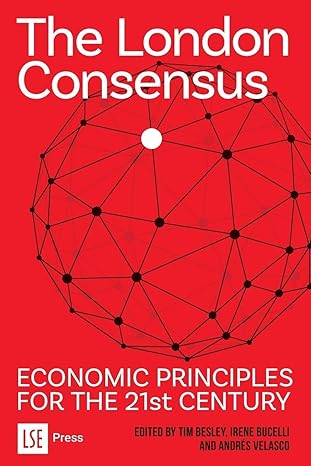
That is precisely what the LSE, through its School of Public Policy, has set out to build. The London Consensus: Economic Principles for the 21st Century, published in October 2025 and co-edited by economists Tim Besley, Irene Bucelli and Andrés Velasco, brings together more than fifty leading academics to propose practical solutions to today’s defining challenges: labour markets, the welfare state, climate, and digitalisation.
Why should an impact business care?
This might seem like territory for ministers and economists. And in part it is. But at Impactco we have long been convinced of something: the public policy context is the soil in which impact entrepreneurship either grows — or dies.
When the dominant framework assumes that markets self-regulate and that the state should step back, impact businesses swim against the current. Fiscal incentives for social investment are scarce. Impact measurement has no recognised standards. Patient capital does not flow.
But when the consensus shifts — when public policy begins to acknowledge that market failures are real, that wellbeing has multiple dimensions, that climate is a central economic variable — the ground shifts. And with it, the opportunities.
What the London Consensus opens up (if we know how to read it)
The LSE project is not just a book: it is a signal of where political thinking will move over the coming years across Europe and beyond. Several of its core threads have direct implications for us.
Labour markets and the future of work. Sir Christopher Pissarides, Nobel Prize in Economics (2010), is one of the authors. His chapter argues that labour markets require active intervention. If that position becomes mainstream policy, there is growing space for business models that integrate training, employment insertion and social cohesion.
The welfare state. The chapter by Nicholas Barr, Professor of Public Economics at the LSE, reframes the role of the state — not as a cost, but as infrastructure. For businesses working in social services, education or health, this matters: it changes how contracts, public tenders and public-private collaborations are designed.
Climate and the environment. If the new framework treats sustainability as a core economic variable — and not as an optional externality — businesses that already integrate environmental impact into their model stop being “niche” and become the reference point.
“Let us not wait for public policy to catch up with us. Let us use this moment to position ourselves where the world is moving.”
My reading from Impactco
What I find most valuable about the London Consensus is not any single chapter. It is that it institutionally legitimises the idea that the market cannot and should not be the sole arbiter of value. That there are public goods, externalities and dimensions of human wellbeing that do not resolve themselves.
For those of us who have spent years building purpose-driven businesses, that is not news. But when the LSE says it — backed by rigorous research and projected towards governments and international institutions — it changes the conversation.
My recommendation: read the book (available free of charge at LSE Press under an open licence), bring it to your team, and ask yourself what opportunities the new framework opens in your sector. Because the consensus is shifting. And impact businesses should be at the centre of that conversation, not watching from the outside.
ImpactCo is a Spanish consultancy specialising in business transformation towards real positive impact. Learn more at impactco.es
Source: Besley, T., Bucelli, I. & Velasco, A. (eds.) (2025). The London Consensus: Economic Principles for the 21st Century. LSE Press. Available open access at press.lse.ac.uk
If this analysis resonates with you, share it with someone who should read it.
Let´s talk →