
A reflection on global mortality data and what it reveals to those shaping the purpose-driven economy.
There’s a question that’s been on my mind ever since we founded Impactco, and the data from Our World in Data has just brought it back to the forefront with uncomfortable clarity:
Why is a person born in Mali ten times more likely to die from a treatable disease than someone born in Denmark?
This isn’t a rhetorical question. It’s at the heart of the problem that the purpose-driven economy must solve—and which, if we’re honest, it hasn’t solved yet.
Every day, 165,000 people die worldwide. Sixty million a year. The cause of their death is not random: it is strongly correlated with where they were born, the healthcare system they inherited, and the economic model that surrounded them their entire lives. That is not fate. It is design. And design can be changed.
- 1.60 million people die each year worldwide
- 75% from noncommunicable diseases
- 1 in 3 deaths in low-income countries: treatable infections
What the data says—and what the headlines don’t
The IHME’s Global Burden of Disease study, visualized by Our World in Data, provides the most comprehensive picture available of what causes human deaths. It includes four decades of data covering every country in the world, broken down by age, sex, and cause.
Globally, 75% of deaths are due to noncommunicable diseases (NCDs): cardiovascular diseases, cancers, diabetes, and chronic respiratory diseases. Heart disease alone kills 1 in 3 people. Cancer kills nearly 1 in 5.
These are the numbers that dominate healthcare systems in the wealthy world. But they are not the numbers that tell the whole story.
Global causes of death — percentage distribution
Global Burden of Disease 2023 · IHME / Our World in Data
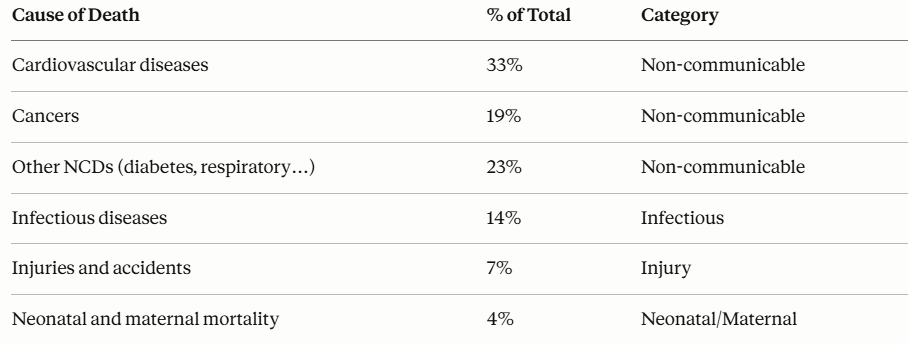
14% of global deaths are caused by infectious diseases. Malaria, tuberculosis, HIV, diarrhea, meningitis. Diseases that the world already knows how to prevent and treat. Diseases that, in most wealthy countries, have virtually disappeared as a cause of death.
Two worlds on the same planet
Causes of death by country income. Percentage of total deaths · IHME GBD 2023
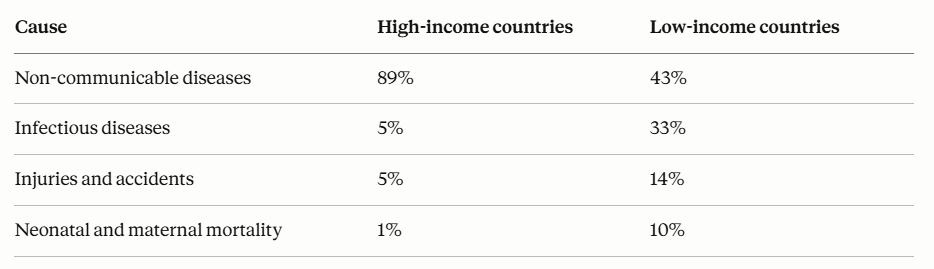
In high-income countries, nearly 90% of deaths are caused by chronic diseases. In low-income countries, 1 in 3 people die from an infection. And—this is the statistic that strikes me the most—1 in 10 deaths is that of a newborn or a mother during childbirth.
One in ten deaths in the poorest countries is of a newborn baby or someone who was trying to bring new life into the world. That’s not just a statistic. It’s a stark indictment of the priorities of the global economic system.
To put this into context: that 10% of neonatal and maternal deaths in poor countries represents four times the number of homicide deaths worldwide. What doesn’t make the headlines often reveals more than what does.
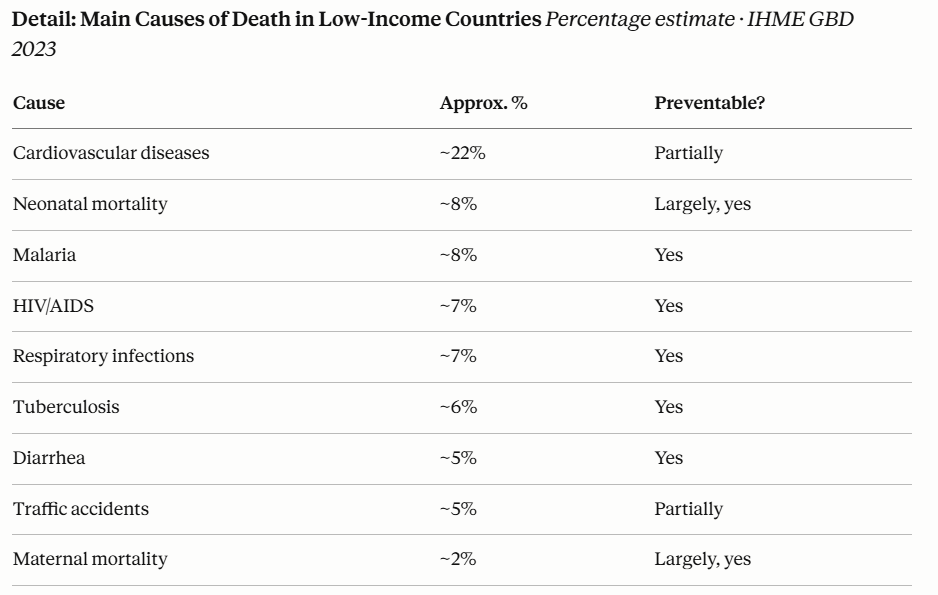
Details: Leading causes of death in low-income countries
What this tells us about the purpose-driven economy
These figures aren’t just about public health. They offer a snapshot of the dominant economic model and reveal where its flaws are most starkly evident. For entrepreneurs, investors, and leaders who operate with a sense of purpose, there are three key takeaways that I believe are essential.
- Prevention is the largest market that no one has ever fully tapped into
In the developed world, 89% of deaths are caused by chronic diseases with modifiable risk factors: a sedentary lifestyle, ultra-processed foods, systemic stress, loneliness, and lack of sleep. We know what causes them. We know, for the most part, how to prevent them. And yet, our healthcare systems remain organized to treat, not to prevent.
There is a huge—and still largely untapped—opportunity for purpose-driven companies: from healthtech to corporate wellness models, from regenerative food to urban design that encourages movement. The investor or entrepreneur who understands that prevention is more profitable than cure—for the system and for the business—is looking in the right direction.
2. Preventable mortality in the Global South is a systemic failure, not a scientific one
We have the tools to eradicate malaria, tuberculosis, and neonatal mortality. There is no lack of scientific knowledge. What is lacking is patient capital, infrastructure, distribution systems, and business models that work in low-income contexts.
This is one of the areas where the purpose-driven economy has the most to offer—and where genuine impact investing can generate returns that purely financial capital cannot even imagine, because it does not measure them. Access to healthcare in emerging markets is not philanthropy in disguise: it is one of the largest underserved markets of the 21st century.
3. The gap is closing—but only where there is a will to close it
The good news—and it must be said—is that mortality from infectious diseases has fallen faster in recent decades than almost any other indicator of well-being. It is the greatest collective achievement of modern public health. Behind this lie political will, public investment, and—yes—private capital with a long-term vision as well.
The bad news is that convergence between rich and poor countries remains slow. And that, on some indicators, the COVID-19 pandemic set back decades of progress in a matter of months.
The speed at which the preventable mortality gap closes is, to a large extent, a function of the capital allocation decisions we make today. The entrepreneurs and investors reading this are part of that equation.
One final thought
When I founded Impactco, I started with a simple conviction: that well-built businesses and real impact are not opposing forces. They are one and the same force, when properly aligned.
These mortality statistics reinforce that conviction—but they also remind me of the urgency. Not because the numbers are dramatic, but because behind every percentage point are real lives, families, and entire communities whose fate should not be determined by the geographical accident of where they were born.
The purpose-driven economy is not a niche. It is the most coherent response we have to some of the world’s most serious problems. And the data from Our World in Data reminds us, every time we look at it, how much remains to be done.
Your place of birth remains the most powerful predictor of what you will die from. Changing that is, quite literally, what this project is all about.
If this analysis resonates with you, share it with someone who should read it.
Let´s talk →