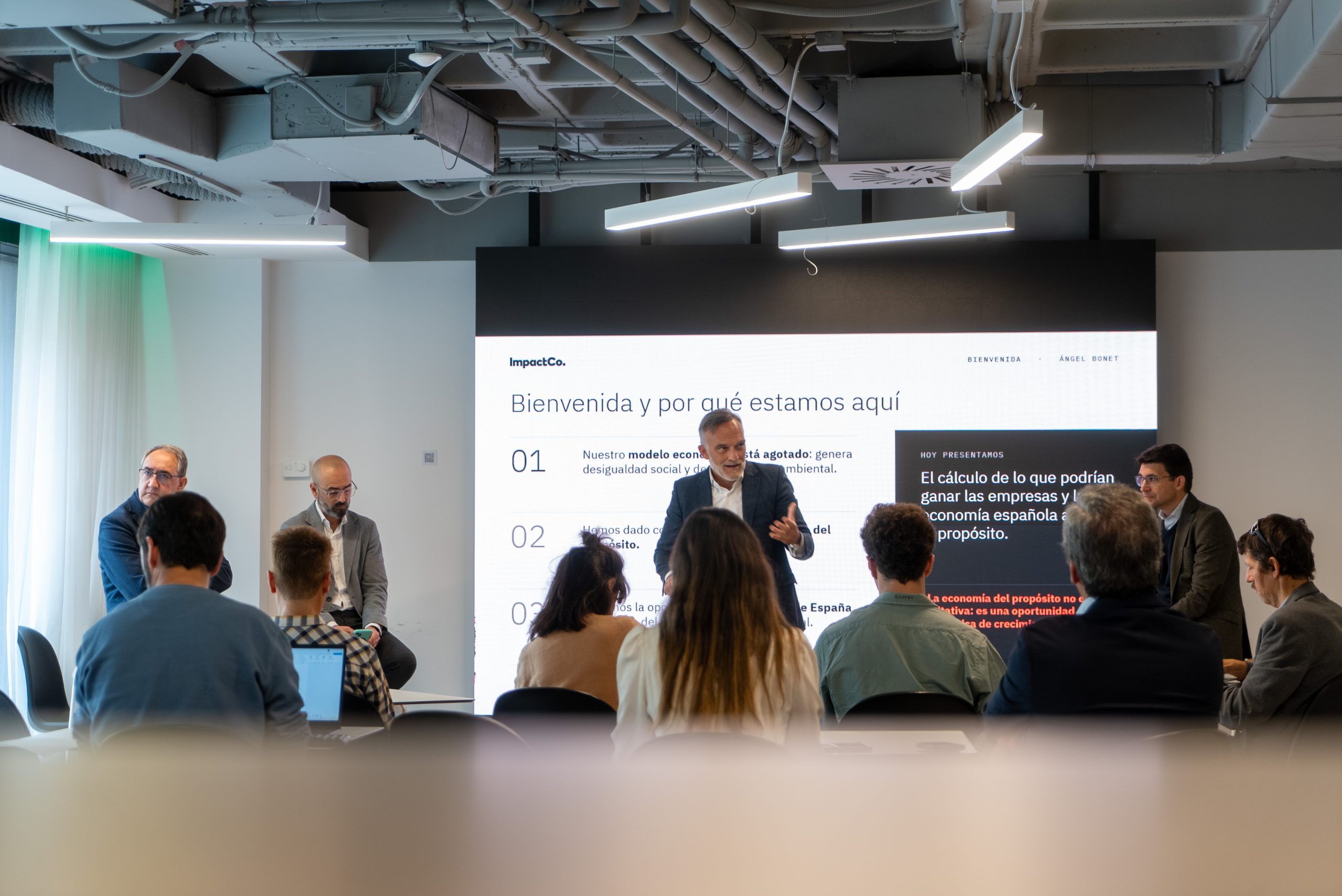
Spain loses €44.5 billion a year because companies fail to activate their purpose. This is the main finding of The Invisible Cost (El coste invisible), the report ImpactCo presented in Madrid on October 27, 2026. In other words, the gap in corporate purpose in Spain costs the economy 2.6% of its GDP.
The report examines the distance between companies that declare a purpose and those that actually apply it in their management. Put simply, it measures the gap between words and action. ImpactCo’s Instituto de la Economía del Propósito prepared the analysis.
What corporate purpose in Spain could add to public finances
The figure does not only affect companies. If businesses activated their purpose, public accounts could collect around €19.6 billion more every year. Moreover, they would do so without raising taxes, widening the deficit or issuing new debt. Instead, the gain would come from stronger economic activity, which lifts tax revenue, and from potential savings in public spending. Therefore, activating corporate purpose in Spain is a public matter, not just a business one.
Growth without shared well-being
The report also highlights a Spanish paradox. The economy keeps growing, yet that growth does not always translate into shared well-being. For example, according to UNICEF, 34.8% of children and adolescents in Spain are at risk of poverty or social exclusion.
“Inequality is a productivity trap: highly unequal economies grow more slowly,” warned Ángel Bonet, founder and president of ImpactCo. In his view, internalizing costs, improving working conditions and investing in training would support more sustainable and inclusive growth. Ultimately, that path would strengthen the middle class, the engine of any healthy economy.
The gap between declared and lived corporate purpose in Spain
According to APD’s first Barometer on Corporate Purpose, 70% of companies in Spain say they have a corporate purpose. However, 39% confuse it with their mission and vision. The gap also shows up in engagement. Only 10% of employees in Spain feel engaged at work, compared with a European average of 12%, according to Gallup.
This lack of engagement has a real price. For instance, absenteeism due to common illness cost the Social Security system and companies €29.1 billion in 2024, according to AMAT. Staff turnover adds to the bill. According to SHRM, replacing an executive or a highly specialized profile can cost up to 400% of their annual salary.
“Companies need a real, implemented purpose that maximizes shared value, meaning economic and social benefits at the same time,” Bonet stressed.
From declaration to action
The report therefore presents purpose as a lever to raise productivity, retain talent, drive innovation and create shared value. To get there, it proposes building purpose into management indicators, investment decisions, pay policy, supplier relationships and impact measurement.
Above all, the authors see the report as a starting point. The Invisible Cost is an outreach report, not a scientific paper. Instead, it lays the groundwork for future research by the Chair of Purpose-Driven Companies at the University of Navarra, which ImpactCo co-founded. It draws on reliable sources and peer-reviewed studies. At the same time, it openly acknowledges that the evidence on corporate purpose in Spain still lacks the scientific depth the issue deserves.
Read more: in October 2026, ImpactCo also hosted its purpose economy partners from the US and India in Madrid.