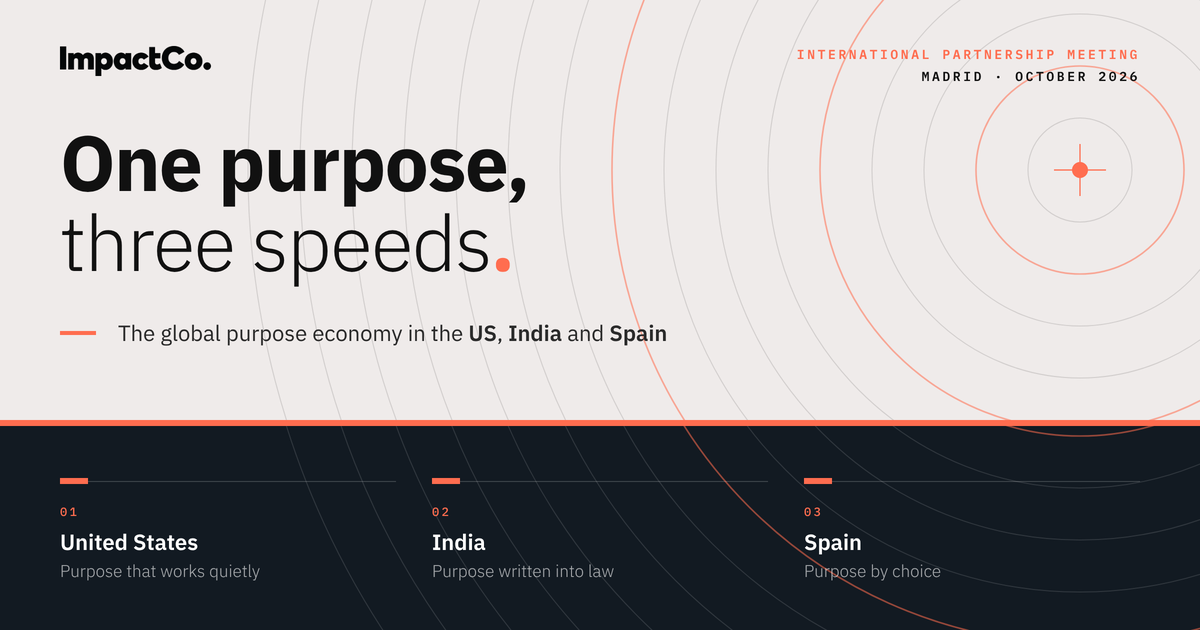
This week, ImpactCo hosts its International Partnership Meeting in Madrid. On October 21 and 22, partners from the United States and India join our team to compare notes. Among them are Simon Rogers, founder of A Little Better Co., and Sam Sathe of Sam Space. The timing matters, because the global purpose economy is not moving at one speed. In fact, it is moving at three.
At ImpactCo, we study purpose-driven business through success stories from around the world. One lesson keeps coming back. Purpose is universal in what it seeks, yet local in how it grows. So, before we sit down together, here is how the picture looks from each market.
The United States: purpose that works quietly
In the US, the federal framework has stepped back. On May 29, 2026, the SEC proposed to rescind its 2024 climate disclosure rules in full. As a result, many companies now say less about sustainability.
Yet investment has not vanished. A 2025 EcoVadis survey of US companies makes the point. Some 31% were raising sustainability investment while cutting public messaging about it. Meanwhile, California now requires large companies doing business in the state to report their emissions.
For leaders, the lesson is simple. In the US, purpose survives where it shows up in performance, not in slogans. Still, silence has a cost, because what is never shared cannot inspire anyone else.
Our question for Madrid: can purpose last without a story?
India: purpose written into law
India shows another face of the global purpose economy. Since April 2014, companies above set thresholds must spend 2% of their average net profit on social programs. India was the first major economy to make corporate social responsibility a legal duty.
The scale is striking. According to the CSR Yearbook 2026, listed companies spent ₹22,563 crore on these programs in fiscal 2025. That is 17.5% more than the year before. Moreover, 1,364 companies met or exceeded the 2% target.
Transparency is rising too. India’s top 1,000 listed companies must publish a Business Responsibility and Sustainability Report. From the fiscal year that began in April 2026, their core indicators also need external assessment or assurance.
All of this happens in a fast-growing economy. The IMF expects India to grow 7% in 2026 and to overtake Japan as the world’s fourth-largest economy in 2027. Trade remains a moving piece, though. A February framework cut US tariffs on Indian goods to 18%. However, in October, India’s finance minister said talks had reached a plateau.
Our question for Madrid: how does a company move from a mandatory percentage to purpose as a business model?
Spain: purpose by choice
Spain offers a third view of the global purpose economy. First, Europe has eased its rules. The EU published the Omnibus I Directive in February 2026. It limits sustainability reporting to firms with over 1,000 employees and €450 million in turnover. The European Commission estimated that this would remove about 80% of the companies first in scope.
At the same time, Spain is growing faster than its neighbors. The IMF forecasts 2.5% growth in 2026, the highest among the large euro area economies. Even so, it expects unemployment to stay near 9.8%.
The ecosystem is ready. Spain has more than 334 certified B Corps, with over 44,000 jobs and close to €16 billion in combined revenue. Since 2022, Spanish law also recognizes the Benefit and Common Interest Company. Four years later, however, this legal form still awaits its implementing regulation.
Our question for Madrid: can Spanish companies turn this freedom into a competitive advantage?
What the global purpose economy has in common
Each market follows its own path. The US moves through the business case. India moves through the law. Spain will need to move through conviction. None of these paths is enough on its own, and each has something to learn from the other two.
Still, all three share one demand. Purpose only survives political cycles when it is measurable, investable and operational. In other words, it has to become a way of running the business, not a message.
Trust supports this view. The 2026 Edelman Trust Barometer found that, globally, business is still the only institution seen as both ethical and competent. That trust is a real asset for the global purpose economy. It is also a responsibility.
Next week: the global purpose economy, seen from Madrid
This week, we are not bringing answers. Instead, we are bringing three questions to the people who live them every day. Next week, we will share what we concluded together and where we think it goes next.
Want to see how ImpactCo helps organizations turn purpose into measurable performance? Visit impactco.es.