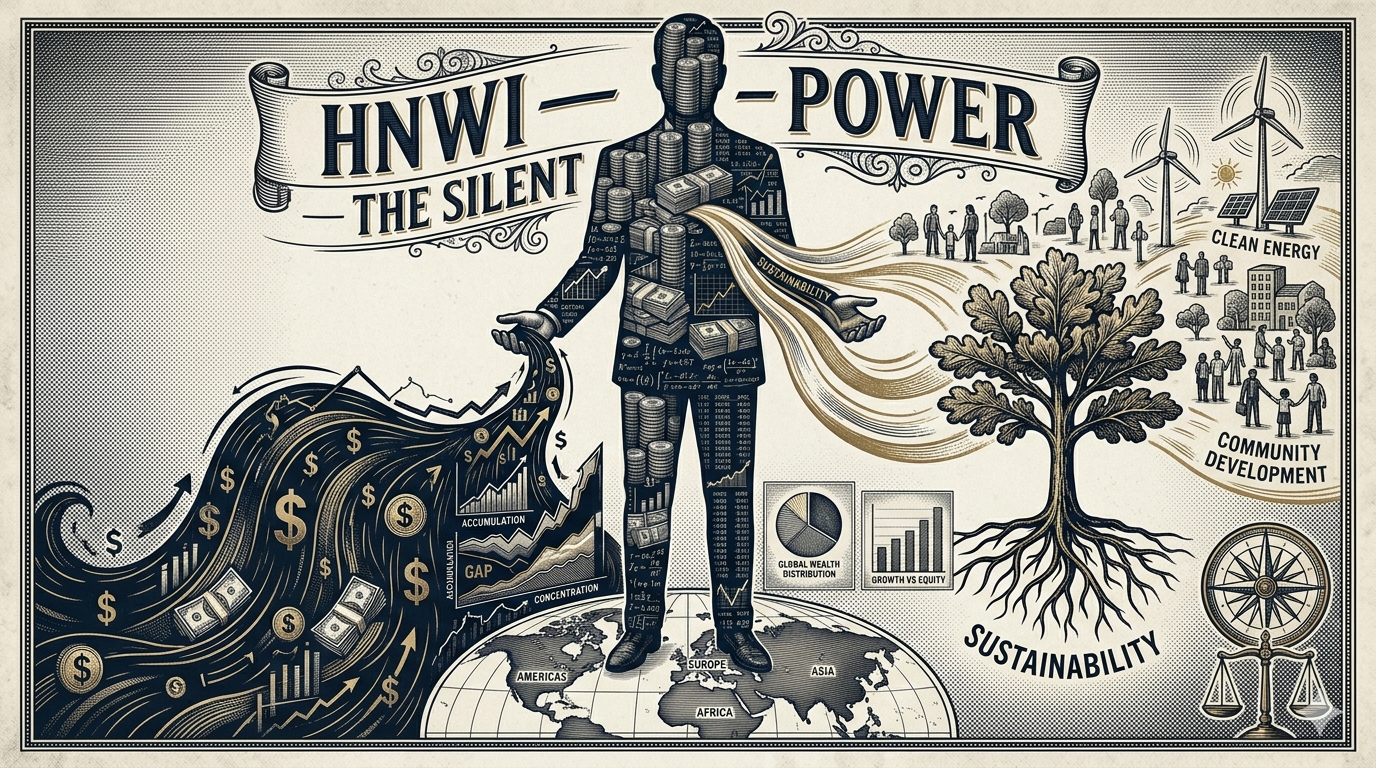
As inequality once again sets the tone of our societies, one acronym is quietly gaining systemic weight. HNWIs are no longer an anecdotal elite. They are, increasingly, one of the most powerful forces shaping the global economy.
At a time when inequality is once again defining the pulse of our societies, one acronym is gaining weight in silence —but with enormous impact: HNWI (High Net Worth Individuals), defined as those with investable financial assets exceeding one million dollars, excluding primary residence.
They are not an anecdotal elite. They are, increasingly, a systemic actor.
How Many HNWIs Are There —and How Much Capital Do They Control?
According to Capgemini’s latest World Wealth Report, the number of HNWIs worldwide has surpassed 22 million individuals, accumulating more than 86 trillion dollars in wealth. To put that into context: a figure roughly equivalent to the combined GDP of the United States and China.
Europe accounts for approximately 25% of these individuals. Spain, while far from the world’s major financial hubs, is home to more than 250,000 HNWIs, according to the UBS Global Wealth Report. A number that continues to grow, driven by asset appreciation, technology and financial globalisation.
But the relevant question is not how many there are.
It is: what are they doing with their money?
Capital That Seeks Meaning, Not Just Returns
Historically, great wealth has played an ambivalent role. It has been an engine of investment, innovation and growth. But it has also, far too often, contributed to entrenching structures of inequality.
Today, we are at an inflection point.
A new generation of HNWIs —many of them heirs, but also tech entrepreneurs— is beginning to question the traditional model of wealth accumulation. According to Morgan Stanley, more than 80% of high-net-worth millennial investors express interest in sustainable investments.
Capital is no longer looking for returns alone. It is beginning to look for meaning.
HNWIs are seeking measurable impact, solid governance and scalable projects that combine financial return with social transformation. Companies that integrate purpose into their core have access to a new source of capital: patient, demanding, long-term capital.
According to the Global Impact Investing Network (GIIN), the impact investing market has already surpassed one trillion dollars globally.
A Word of Caution: This Is Not All Philanthropy
The rise of HNWIs also raises obvious risks: concentration of economic power, disproportionate influence over public agendas and dependence on private visions that are not subject to democratic mandate.
The real challenge is not simply attracting this capital.
It is channelling it correctly.
We are witnessing one of the greatest redistributions of capital in history: the generational wealth transfers expected over the next two decades will exceed 80 trillion dollars globally, according to multiple private banking projections. A tide of wealth in search of direction.
The question is not whether that money will change the world.
It is which direction it will take.
Purpose as the Investment Criterion of the 21st Century
Because capital does not define the future.
What defines it is the purpose with which it is used.
At ImpactCo, we work with companies and leaders who understand this reality: that attracting HNWI capital today requires far more than a compelling financial deck. It demands a credible impact narrative, aligned governance and a purpose strategy that can withstand the scrutiny of the world’s most demanding investors.
Because smart money no longer funds projects.
It funds legacies.
If this analysis resonates with you, share it with someone who should read it.
Let´s talk →